Today was Bump Day at the Indianapolis Motor Speedway, and the starting grid for the 100th Anniversary Indianapolis 500 is set. Seven cars did not make the show, namely the cars of Ho-Pin Tung, Scott Speed, Rafa Matos, James Jakes, Mike Conway, Ryan Hunter-Reay, and Sebastian Saavedra. Last year, I broke down the stories in terms of the good, bad, and the ugly, and I will continue with that tradition. First, however, I feel I need to explain the qualification procedures for the 500.
There were two days of qualifying. The first is known as "Pole Day," as the polesitter of the race is determined. This was yesterday (Saturday). On Pole Day, the first 24 spots were filled. For the last hour, the Fastest Nine cars requalified and were guaranteed a spot no worse than ninth.
Today was the second day of qualifying, known as "Bump Day." Here, the final three rows are filled to position 33. After all spots are filled, the slowest car is "on the bubble." For a car to make the race, it has to post a speed faster than the slowest car. If they accomplish this, the slowest car is bumped from the field, and the new car takes its appropriate place by speed among the Bump Day qualifiers.
There was more drama throughout qualifying than I can recall in my time following IndyCar. Granted, I am only 23, so surely there was more drama in other years, but it was still incredible considering that just a few years ago it was a huge struggle to even get 33 cars entered for the race.
Without further adieu, here are the good, the bad, and the ugly throughout qualifying for the 500.
The Good
There were tons of great stories throughout qualifying. Only three of the five combined Penske and Ganassi cars were in the Fast Nine, and only one of the Penske cars made it.
Alex Tagliani on the pole is amazing. He was surprisingly quick in practice all week, but I knew for sure that Penske and Ganassi were sandbagging and would take the first five spots of the grid. Alex is a great guy and I hope his car continues to be fast as they work on the race set-up on it. The same can be said for Oriol Servia, who will be starting third.
Buddy Rice and Dan Wheldon are two former Indy 500 champions, and both are without full-time rides. Buddy hasn't driven in an IndyCar in years, and he showed that he still deserves to drive one. Both came in on short notice and really turned heads, and I hope their performances can turn into more races for them throughout the season.
Ed Carpenter was also impressive in the Dollar General car of Sarah Fisher Racing. They are an oval-only program, and this is the first oval of the year, and they really turned some heads.
Simona also did a good job of getting the car in the field. She crashed her car pretty bad during practice this week and suffered third degree burns on her hands. This was not the first time she has been burned in a crash, and she showed amazing toughness and fortitude to get the car in the field on Pole Day.
The Bad
The Penske cars certainly were not to form during qualifying. Only Will Power made it into the Fast Nine, Helio Castroneves, a three-time 500 winner, only made it to 16th, and Ryan Briscoe came in 27th on Bump Day in his backup after wrecking his primary on Pole Day.
Scott Dixon did well for Ganassi starting second, and Dario Franchitti may very well have been on the first row with his teammate, but he ran out of fuel on the final lap of his requalification during the Fast Nine. A very curious mistake for such an experienced team!
Ganassi's second team didn't do so well either with the cars of Charlie Kimball and Graham Rahal. There must not be much information being shared between the flagship and the apprentice teams, as Kimball and Rahal start next to each other on row 10 in 29th and 30th.
Also feel bad for Sebastian Saavedra, as he has not had good luck at Indy. Last year, he crashed his car on Bump Day, and started the race 33rd after being bumped INTO the field when Paul Tracy withdrew his time good enough for 33rd and failed to be quick enough to make it into the race, all while Sebastian was in a hospital bed. He struggled throughout May last year, and continued the struggle this year.
The Ugly
Andretti Autosport really fell from grace. All week during practice, only Danica and John Andretti's cars were consistently quick. Only John Andretti managed to get into the field on Pole Day. Danica made it in pretty solidly on Bump Day, and Marco Andretti bumped his teammate Ryan Hunter-Reay out of the race when he posted a time quick enough to make it in. The disparity between their oval and road course programs are amazing. They have been near the front on the road courses, and have thoroughly struggled all week. The fifth car of Mike Conway also failed to make the race. Conway and Hunter-Reay are the last two winners of the Long Beach Grand Prix, the most prestigious street race in the United States, and both will be watching the race while three of their teammates are in the race.
Dragon Racing did not come to the track prepared. They entered only two cars, and neither had a back-up. They brought Ho-Pin Tung and Scott Speed with them, both rookies to formula oval racing IndyCar. Ho-Pin Tung crashed his car yesterday and suffered a concussion. Scott Speed was formerly an F1 driver, and I expected better of him. He had no idea what was going on all week, and on the morning of Pole Day he left the track because he was so frustrated with the team. Patrick Carpentier stepped into the car Sunday morning and crashed it as well. With no backups, the team had to pack up and leave. They are entered to run the Firestone Twin 275s on June 11 with Paul Tracy, and it will be a miracle if they are able to show up.
It was an interesting week of practice and qualifications. The media storm is this week, as well as a few more practice sessions to hone in on the race set-up. After I see how those practice sessions are going, I'll put up a post entailing my predictions for the race.
Showing posts with label auto racing. Show all posts
Showing posts with label auto racing. Show all posts
Sunday, May 22, 2011

Wednesday, May 11, 2011
2012 IndyCar "Unveiled"
Yesterday, the 2012 IndyCar was "unveiled" at the Indianapolis Motor Speedway. I say "unveiled" because they are not representative of what Dallara is actually designing for its aero kits. They goal was more to show the fans the direction they were headed in, and show designers the freedom they have in making aero kits, as the road course and oval kits are vastly different, as shown below.
 |
| Road course car on left, oval on right |
The oval car has a very sleek profile. One thing people are already complaining about are the totally sheathed rear wheels (well, the top of the wheel is open, but that doesn't really count).

As an aerodynamicist, I love this move. I absolutely love open wheel formula racing, but when I see open wheels, the aerodynamicist side of me shudders. The wheels are a bluff body, which means they produce TONS of drag. An aerodynamic fact that can be proven mathematically (I've been trying to find the proof since I KNOW we did it in my fluids class junior year, but I can't find it) is that a cylinder and an airfoil whose maximum thickness is 27 times the thickness of the cylinder produce the same amount of drag. In essence, they surround the bluff body with a streamlined body to reduce drag. Totally awesome.
On both cars, the bodywork surrounds the rear wheel. This was already confirmed from the initial conceptual design phase so as to avoid accidents involving interlocking tires. I think they did a good job here of producing a car that looks like an open wheel car, even though it isn't truly an open wheel car.
People are also complaining about the fin that extends from the roll hoop to the rear wing. This is, again, something I love as an aerodynamicist. It prevents vortex shedding and the flows from either side of the engine cowling from mixing into a big turbulent mess before getting to the rear wing, where most of the car's downforce is produced.
Tons of people are getting all riled over the new cars. Dallara came out beforehand and stated that this is in NO WAY representative of the direction they are going with their aero kits, but it was more to show fans that they are making progress, and to show potential aero kit manufacturers that they have plenty of freedom with their designs.
I will refrain from judgment until a test car gets on track this summer.
Thursday, April 28, 2011
The Science of Racing: Tires
I don't get to talk about racing enough, so I've created a new series where I'll get to do just that. Once a week (if time allows) I would like to talk about something that makes a race car far different from the one you drive all the time. A big one is aerodynamics. That, however, is my bread and butter, so I'll save it for later.
The first component I would like to talk about is inarguably the most important part for any automobile: the tires! Why are they the most important, you ask? It's the only part of the car that actually touches the ground!
At first glance. a race tire looks fairly similar to your ordinary road tire.
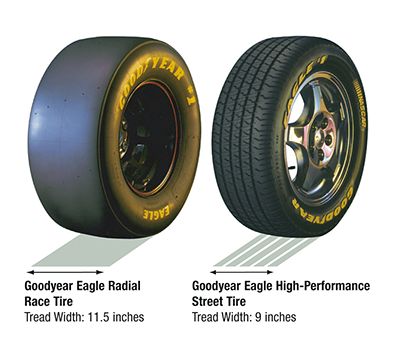
They couldn't be any more different, however. The most noticeable difference is the tread pattern. Typically, the tread of a race tire is slick, as shown above. This is to maximize the tire's contact patch with the ground, thereby maximizing grip. Many formula racing series do have rain tires for when it rains when they are running on road and street courses. This look much like a road tire in that there is a tread pattern rather than being slick. There are two different sets of rain tires, intermediates, and full wets. Intermediates are used when the track is wet, but little or no water is actually falling onto the track, whereas full wets are used when there is steady, consistent rain falling on the track. There are even more tread patterns for dirt tires, ice tires, etc. My specialty is formula racing, where neither of these are used, so I won't talk about them.
Many other differences come about due to the speed difference. Road tires are typically designed to maintain speeds up to 100 mph, where as a race tire has to endure speeds of over 200 mph! This means that the sidewall of the tire (the part where the manufacturer paints their logo) must be very sturdy so that the tire does not flex much. Speeds this high, as I'm sure you can imagine, lead to very high amounts of friction, and the tire starts heating up quite significantly, usually around temperatures where water begins to boil. To maintain the integrity of the tire and to keep it from blistering, the treads are incredibly thin, around the thickness of a credit card for slick tires (!!!). This temperature increase also means that the cold pressure of a racing tire is generally fairly low, around 20 psi where your car's tires have around 35 psi. Rain tires have much thicker treads and carry higher amounts of heat, but are cooled by the water on the track, so it is less of an issue. You typically want the temperature of the tire to be uniform, as this means that the entire surface of the tire was in contact with the road. If the middle of the tire is warmer than the edges, the tire is overinflated (and the other way around). Although for initial tests, it may be beneficial to overinflate the tire to see if the suspension needs tweaking to ensure an even contact patch (more on suspension at another point in time). You may have also noticed that pit crews seem to work effortlessly when changing tires, when you know your tires to be relatively heavy. It is not because the crew has superhuman strength, it is because the tire is so light!
Another thing to note is that the compound of the tire changes from track to track. Most tires are made of a synthetic rubber made from various chemicals, and the change in the recipe of the chemicals lead to a different end compound. These compounds change the overall "grippiness" of the tire. A tire with lots of grip is said to be "soft," and a tire with less grip is said to be "hard." There is a trade-off, however. Softer tires tend to degrade much quicker than hard tires, to you may only get a few laps of tire integrity before they start wearing away. (Yes, even race tires wear!)
I'm no expert on tires, and I'm sure there's far more that goes into them than even what I explained! I bet you never realized just how much goes on with something as mundane as tire. Race tire scientists and engineers certainly earn their income! I cannot remember the last time a Firestone failed in an IndyCar race.
Hopefully I'll get to keep doing these about once a week. Since I already alluded to it in this post, I'll probably talk about suspension next. Finals are next week, as well as checking residents out of the hall. It may be more like a week and a half, if not two weeks. If you have any questions, feel free to comment!
Wednesday, November 17, 2010
BREAKING: Lotus to Supply IndyCar Engines in 2012
On Facebook, I saw an announcement from IndyCar's page that said that there would be an announcement regarding a THIRD engine manufacturer for 2012. I was completely shocked and excited by this. After perusing TrackSide Online and SpeedTV, I learned that Lotus would be coming along in addition to Honda and Chevrolet with the backing of Cosworth, and an official announcement is being made tomorrow at the Los Angeles Auto Show.
Group Lotus is making a return to auto racing, perhaps prompted by their name being used in Formula One this year, though they aren't actually affiliated with the F1 team. They had an IndyCar run by KV Racing Technology branded, and had recently announced that they were looking to expand that partnership to two or three cars for 2011, and would develop aero kits in 2012. It's great to see such manufacturer involvement after having no competition (Honda engines, Dallara chassis) since 2006.
The deadline for entering competition in 2012 has passed (certainly for engine competitors, not sure about aero kits), so Honda, Chevrolet, and Lotus will be the three engine manufacturers for 2012. There are also rumors that Fiat wants to join IndyCar as well with their Alfa-Romeo brand, but they'd have to come in 2013 at the earliest. There was also a recent quote from IndyCar CEO Randy Bernard that he was hopeful for another competitor for 2013. Was he referring to Alfa-Romeo? Or Lotus? Or another manufacturer all together?
Whatever the case may be, we have Honda, Chevy, and Lotus committed to making engines for 2012. In addition, Dallara will be designing an aero kit to go with their Safety Cell (all cars will be using the Dallara Safety Cell), Lotus was already committed to designing an aero kit, and GM hinted that they may be doing so as well during their press conference last week announcing the Chevrolet commitment. With Lotus and GM making aero kits, I wouldn't be surprised to see Honda make one as well. I've also heard rumors that Lockheed Martin is potentially interested in supplying an aero kit. Long story short, there will be three engines and at least two, probably three, maybe four or more aero kits in 2012, with the potential for more engine and aero kit manufacturers in later seasons. That gives at least six different configurations possible for 2012, which is way more than the one we will have had for six seasons prior.
Is it bad that I am looking way more forward to the 2012 season, and don't really care what happens in 2011?
Group Lotus is making a return to auto racing, perhaps prompted by their name being used in Formula One this year, though they aren't actually affiliated with the F1 team. They had an IndyCar run by KV Racing Technology branded, and had recently announced that they were looking to expand that partnership to two or three cars for 2011, and would develop aero kits in 2012. It's great to see such manufacturer involvement after having no competition (Honda engines, Dallara chassis) since 2006.
The deadline for entering competition in 2012 has passed (certainly for engine competitors, not sure about aero kits), so Honda, Chevrolet, and Lotus will be the three engine manufacturers for 2012. There are also rumors that Fiat wants to join IndyCar as well with their Alfa-Romeo brand, but they'd have to come in 2013 at the earliest. There was also a recent quote from IndyCar CEO Randy Bernard that he was hopeful for another competitor for 2013. Was he referring to Alfa-Romeo? Or Lotus? Or another manufacturer all together?
Whatever the case may be, we have Honda, Chevy, and Lotus committed to making engines for 2012. In addition, Dallara will be designing an aero kit to go with their Safety Cell (all cars will be using the Dallara Safety Cell), Lotus was already committed to designing an aero kit, and GM hinted that they may be doing so as well during their press conference last week announcing the Chevrolet commitment. With Lotus and GM making aero kits, I wouldn't be surprised to see Honda make one as well. I've also heard rumors that Lockheed Martin is potentially interested in supplying an aero kit. Long story short, there will be three engines and at least two, probably three, maybe four or more aero kits in 2012, with the potential for more engine and aero kit manufacturers in later seasons. That gives at least six different configurations possible for 2012, which is way more than the one we will have had for six seasons prior.
Is it bad that I am looking way more forward to the 2012 season, and don't really care what happens in 2011?
Friday, November 12, 2010
Chevy Returns!
Today, it was announced that Chevrolet would return to competition in the IZOD IndyCar Series starting in the 2012 season with a V6 turbocharged direct-injection engine. They will be partnering with Ilmor Engineering in Plymouth, MI, a racing engine supplier, to design their engine.
This is great news for IndyCar racing. Competition generally attracts more sponsors, which is something IndyCar is desperate for. It also attracts more fans, because, let's face is, most Americans are going to be more impressed to hear that Chevrolet won the Indianapolis 500 rather than Honda (or any other foreign manufacturer, for that matter).
It was also announced that Team Penske would be running Chevrolet engines beginning with the 2012 season. Penske and Chevrolet was already a great pairing, as the pair had won 31 races, including 4 Indy 500s before Chevrolet left the sport in the middle of the decade.
The one downside is that this will bring costs up slightly. If Honda were to remain the sole supplier, an engine lease was expected to come in at less than $600k for the season, but with competition, the series has an engine lease capped at $690k. However, costs will still be around half of what they presently are, and there will be far more benefits with the addition of engine competition.
There are also rumors floating around that GM may want to supply aero kits as well, and Lotus may also supply aero kits. I look forward to the 2012 season more and more each day when the new spec is debuted? Have a likely lackluster 2011 season to get through first, though.
This is great news for IndyCar racing. Competition generally attracts more sponsors, which is something IndyCar is desperate for. It also attracts more fans, because, let's face is, most Americans are going to be more impressed to hear that Chevrolet won the Indianapolis 500 rather than Honda (or any other foreign manufacturer, for that matter).
It was also announced that Team Penske would be running Chevrolet engines beginning with the 2012 season. Penske and Chevrolet was already a great pairing, as the pair had won 31 races, including 4 Indy 500s before Chevrolet left the sport in the middle of the decade.
The one downside is that this will bring costs up slightly. If Honda were to remain the sole supplier, an engine lease was expected to come in at less than $600k for the season, but with competition, the series has an engine lease capped at $690k. However, costs will still be around half of what they presently are, and there will be far more benefits with the addition of engine competition.
There are also rumors floating around that GM may want to supply aero kits as well, and Lotus may also supply aero kits. I look forward to the 2012 season more and more each day when the new spec is debuted? Have a likely lackluster 2011 season to get through first, though.
Tuesday, November 2, 2010
The Giants Win the World Series?!?
Baseball season has come to an end, and the Giants have won the World Series. When the season started, the Giants were the last team I saw seeing the World Series. I knew they were good, I just didn't think they had the swagger to win a World Series, but they proved me wrong.
Baseball season is over, racing season is over (because NASCAR isn't racing), and football is pretty much already dead to me, as both Purdue and the Bears totally suck. Purdue's basketball team will be disappointing after Robbie Hummel tore his ACL AGAIN, and NBA basketball is too flashy to feel too strongly for the Bulls. The Blackhawks will have another decent season, but I don't see them winning the Stanley Cup again.
145 more days until IndyCar opens the season on March 27 in St. Petersburg, FL, and 150 days until the Cubs open their season at home on April 1 against the Pirates!
Baseball season is over, racing season is over (because NASCAR isn't racing), and football is pretty much already dead to me, as both Purdue and the Bears totally suck. Purdue's basketball team will be disappointing after Robbie Hummel tore his ACL AGAIN, and NBA basketball is too flashy to feel too strongly for the Bulls. The Blackhawks will have another decent season, but I don't see them winning the Stanley Cup again.
145 more days until IndyCar opens the season on March 27 in St. Petersburg, FL, and 150 days until the Cubs open their season at home on April 1 against the Pirates!
Monday, October 4, 2010
Two 2010 Seasons Conclude
This weekend saw the conclusion of both the regular season in MLB, as well as the final race of the year for the IZOD IndyCar Series. Seeing as these are two of my favorite sports EVER, naturally, I'm going to talk about it.
First, the MLB. My Cubs finished in 5th place in the NL Central. I was impressed, however. They only finished 12 games below .500, and had been as low as 22 games under. The youth of the team put together a really good streak toward the end, and I'm excited to see what they can do next year. I think that it was obvious the players had given up on Lou Piniella, as the team really excelled after Lou's departure. I hope that Ryne Sandberg is hired as the manager starting next year. He is a great baseball personality and a true student of the game. If the Cubs don't pick him up, someone else will, and it would be terrible for the Cubs to lose Ryno.
I'm thinking it's gonna be a Rays/Phillies World Series. After coming so close last year to winning, and due to the relative inexperience of the Tampa Bay Rays, the Phillies will come in and take the series in 6. That's about a month away though.
Saturday night saw the final race of the 2010 IZOD IndyCar Series at Homestead-Miami Speedway. First off, it was immediately clear why the series will not be returning to Homestead next year, as there couldn't have been any more than 5000 people in the stands, and that is a VERY liberal estimate. You're only as strong as your weakest link, and Homestead has definitely been one of the weakest links for awhile.
I was disappointed with the way the season ended. Will Power entered the race with an 11 point lead over Dario Franchitti for the championship, and just had to finish ahead of him to ensure a championship, but could have been within a couple spots of Dario, depending on where he finished. Dario dominated the race, and wrapped up the two bonus points fairly early in the race for leading the most laps. Will, as he is seemingly prone to do, choked under pressure, got the car in the marbles, and hit the wall about two-thirds through the race. From there it was Dario's championship to lose, but he finished the race and brought home the championship.
First off, this is a great string for Dario. He has won the 2007, 2009, and now 2010 titles. These are the last three seasons he participated in, as he took a year off in 2008 to try his hand in NASCAR. When you consider the fact he's won the championship each of the last three years he's tried, it's quite an impressive feat.
I am also starting to fear for Will's racing career. He had a seemingly insurmountable points lead just one month ago, and Dario was able to topple it relatively easily. A couple years ago, Will was running away with the race at Surfers' Paradise, his home race in Australia, when he stuffed his car in the tire barrier. He really needs to gain composure under high-stress situations in the car. He has amazing talent and is quite possibly the best IndyCar racer since Rick Mears, but he doesn't have anything to show for it.
This leaves one year left with the current spec until the new car comes in 2012. While next season will surely be much of the same Penske and Ganassi domination, I am hopeful other teams could be more competitive. At the very least, there will hopefully be some new(ish) names up front. Graham Rahal has secured funding for a full season next year, and should be near the top, no matter which team he runs for. Justin Wilson also did a fantastic job making something of nearly nothing in his drive with Dreyer & Reinbold this season. No matter where he winds up next season, it should be a step up from where he currently is, and I look forward to seeing what he is capable with better equipment under him.
First, the MLB. My Cubs finished in 5th place in the NL Central. I was impressed, however. They only finished 12 games below .500, and had been as low as 22 games under. The youth of the team put together a really good streak toward the end, and I'm excited to see what they can do next year. I think that it was obvious the players had given up on Lou Piniella, as the team really excelled after Lou's departure. I hope that Ryne Sandberg is hired as the manager starting next year. He is a great baseball personality and a true student of the game. If the Cubs don't pick him up, someone else will, and it would be terrible for the Cubs to lose Ryno.
I'm thinking it's gonna be a Rays/Phillies World Series. After coming so close last year to winning, and due to the relative inexperience of the Tampa Bay Rays, the Phillies will come in and take the series in 6. That's about a month away though.
Saturday night saw the final race of the 2010 IZOD IndyCar Series at Homestead-Miami Speedway. First off, it was immediately clear why the series will not be returning to Homestead next year, as there couldn't have been any more than 5000 people in the stands, and that is a VERY liberal estimate. You're only as strong as your weakest link, and Homestead has definitely been one of the weakest links for awhile.
I was disappointed with the way the season ended. Will Power entered the race with an 11 point lead over Dario Franchitti for the championship, and just had to finish ahead of him to ensure a championship, but could have been within a couple spots of Dario, depending on where he finished. Dario dominated the race, and wrapped up the two bonus points fairly early in the race for leading the most laps. Will, as he is seemingly prone to do, choked under pressure, got the car in the marbles, and hit the wall about two-thirds through the race. From there it was Dario's championship to lose, but he finished the race and brought home the championship.
First off, this is a great string for Dario. He has won the 2007, 2009, and now 2010 titles. These are the last three seasons he participated in, as he took a year off in 2008 to try his hand in NASCAR. When you consider the fact he's won the championship each of the last three years he's tried, it's quite an impressive feat.
I am also starting to fear for Will's racing career. He had a seemingly insurmountable points lead just one month ago, and Dario was able to topple it relatively easily. A couple years ago, Will was running away with the race at Surfers' Paradise, his home race in Australia, when he stuffed his car in the tire barrier. He really needs to gain composure under high-stress situations in the car. He has amazing talent and is quite possibly the best IndyCar racer since Rick Mears, but he doesn't have anything to show for it.
This leaves one year left with the current spec until the new car comes in 2012. While next season will surely be much of the same Penske and Ganassi domination, I am hopeful other teams could be more competitive. At the very least, there will hopefully be some new(ish) names up front. Graham Rahal has secured funding for a full season next year, and should be near the top, no matter which team he runs for. Justin Wilson also did a fantastic job making something of nearly nothing in his drive with Dreyer & Reinbold this season. No matter where he winds up next season, it should be a step up from where he currently is, and I look forward to seeing what he is capable with better equipment under him.
Monday, September 13, 2010
Laying the Foundation
I know I have had a lot of IndyCar related posts lately, but lots of news has been spewing from the world of IndyCar.
Randy Bernard, IndyCar CEO, spent the first week and a half of September in Europe, talking to potential engine manufacturers and F1 teams trying to garner interest in the series, inviting any and all manufacturers to supply engines and/or aero kits for the new spec coming in 2012, as well as introducing himself. From the sounds of things, people were very receptive and welcoming of him and his vision for the new IndyCar. Hopefully good things come from this, and we will again have several engine suppliers and several aero kit providers! Brief article about his trip can be found here.
Also, Tony Cotman, the man who is in charge for writing the technical details for the 2012 car, has also been working very hard. He started a blog on Racer which will encapsulate his work and give details as they are announced. His first blog states that they need to get the size of the engine compartment specified in the next 30-45 days, that way, potential engine suppliers will have plenty of time for development. Cotman is hopeful they can begin on-track testing in September 2011, which means Cotman will have his work cut out for him.
Another thing I found interesting about his first post is that he has his mind on driver comfort. The current cars are fine for the short drivers such as Danica Patrick (5'2") and E.J. Viso (5'5"), but the tall drivers like Justin Wilson (6'3") and Graham Rahal (6'2") really have to fold themselves up and pack themselves into the current cars. Justin often reports bruised elbows and knees from being packed into the current car and being subjected to 3+ G's for a substantial period of time. Cotman notes that next month, they will fly drivers out to Italy (Dallara, the company manufacturing the standard IndyCar safety cell, is based in Italy) to ensure that all drivers will be able to fit into the new car. That's a true engineering mindset, thinking about more than the obvious! Cotman's first post can be found here.
Just two months ago, the 2012 IndyCar was nothing more than a few computer models. I am very excited to see the project actually gaining momentum with some actual facts, figures, and photos arriving in the coming months!
Randy Bernard, IndyCar CEO, spent the first week and a half of September in Europe, talking to potential engine manufacturers and F1 teams trying to garner interest in the series, inviting any and all manufacturers to supply engines and/or aero kits for the new spec coming in 2012, as well as introducing himself. From the sounds of things, people were very receptive and welcoming of him and his vision for the new IndyCar. Hopefully good things come from this, and we will again have several engine suppliers and several aero kit providers! Brief article about his trip can be found here.
Also, Tony Cotman, the man who is in charge for writing the technical details for the 2012 car, has also been working very hard. He started a blog on Racer which will encapsulate his work and give details as they are announced. His first blog states that they need to get the size of the engine compartment specified in the next 30-45 days, that way, potential engine suppliers will have plenty of time for development. Cotman is hopeful they can begin on-track testing in September 2011, which means Cotman will have his work cut out for him.
Another thing I found interesting about his first post is that he has his mind on driver comfort. The current cars are fine for the short drivers such as Danica Patrick (5'2") and E.J. Viso (5'5"), but the tall drivers like Justin Wilson (6'3") and Graham Rahal (6'2") really have to fold themselves up and pack themselves into the current cars. Justin often reports bruised elbows and knees from being packed into the current car and being subjected to 3+ G's for a substantial period of time. Cotman notes that next month, they will fly drivers out to Italy (Dallara, the company manufacturing the standard IndyCar safety cell, is based in Italy) to ensure that all drivers will be able to fit into the new car. That's a true engineering mindset, thinking about more than the obvious! Cotman's first post can be found here.
Just two months ago, the 2012 IndyCar was nothing more than a few computer models. I am very excited to see the project actually gaining momentum with some actual facts, figures, and photos arriving in the coming months!
IndyCar Rebranded
In the same announcement that saw the 2011 IndyCar schedule revealed, another change was revealed.
In 1994, Tony George split from CART, forming the Indy Racing League. Before the start of the 2008 season, the remnants of both series merged back together under the IRL banner. During "The Split" as it's affectionately been named, IndyCar racing fell from a state of being nearly the most popular form of motorsport in the world, second only to Formula 1 on a global scale, and actually attracting Formula 1 drivers to it, to confused fans not knowing which side to follow, and generally following NASCAR instead.
The terms Indy Racing League and IRL has beleaguered many fans who stayed on the CART (which eventually became Champ Car) side, and Randy Bernard, IndyCar CEO, has acknowledged this. Starting with the 2011 season, the sanctioning body of the IZOD IndyCar Series and the Firestone Indy Lights will be known as IndyCar. Fans world over know the style of racing as IndyCar, and hopefully, this will bring many of them back.
Also, based on the press conference, I have to infer that more of the sport's history will be included. The IRL always treated their races as the only IndyCar races ever, and doesn't account for previous decades of history. For instance, Scott Dixon is listed as the winningest IndyCar driver with 23 wins, when the actual record belongs to Mario Andretti with 52. I can only hope this inference is correct, because I cringe during race broadcasts when it is claimed that Scott Dixon has won the most IndyCar races and that Sam Hornish Jr. has led the most laps in IndyCar competition. There's a good 80 years of history they've been neglecting.
Bernard hasn't been in charge for 12 months yet, and he's already making fantastic changes. He is the former CEO of Professional Bull Riding, and brought it from the little mom & pop run event to the media conglomerate it is now. Hopefully he continues to listen to fans and make the proper decisions in growing IndyCar back to its original status and hopefully toppling NASCAR. (Side note - did you know we are the only nation that takes stock car racing seriously? Because we are. It's a joke everywhere else. It's a sign of a BAD DRIVER to race stock cars.)
In 1994, Tony George split from CART, forming the Indy Racing League. Before the start of the 2008 season, the remnants of both series merged back together under the IRL banner. During "The Split" as it's affectionately been named, IndyCar racing fell from a state of being nearly the most popular form of motorsport in the world, second only to Formula 1 on a global scale, and actually attracting Formula 1 drivers to it, to confused fans not knowing which side to follow, and generally following NASCAR instead.
The terms Indy Racing League and IRL has beleaguered many fans who stayed on the CART (which eventually became Champ Car) side, and Randy Bernard, IndyCar CEO, has acknowledged this. Starting with the 2011 season, the sanctioning body of the IZOD IndyCar Series and the Firestone Indy Lights will be known as IndyCar. Fans world over know the style of racing as IndyCar, and hopefully, this will bring many of them back.
Also, based on the press conference, I have to infer that more of the sport's history will be included. The IRL always treated their races as the only IndyCar races ever, and doesn't account for previous decades of history. For instance, Scott Dixon is listed as the winningest IndyCar driver with 23 wins, when the actual record belongs to Mario Andretti with 52. I can only hope this inference is correct, because I cringe during race broadcasts when it is claimed that Scott Dixon has won the most IndyCar races and that Sam Hornish Jr. has led the most laps in IndyCar competition. There's a good 80 years of history they've been neglecting.
Bernard hasn't been in charge for 12 months yet, and he's already making fantastic changes. He is the former CEO of Professional Bull Riding, and brought it from the little mom & pop run event to the media conglomerate it is now. Hopefully he continues to listen to fans and make the proper decisions in growing IndyCar back to its original status and hopefully toppling NASCAR. (Side note - did you know we are the only nation that takes stock car racing seriously? Because we are. It's a joke everywhere else. It's a sign of a BAD DRIVER to race stock cars.)
2011 IndyCar Schedule Revealed
On Friday, the schedule for the 2011 IndyCar season was announced. Before I give my opinion, the schedule is as follows:
MARCH 27 – St. Pete (street circuit)
APRIL 10 – Birmingham, Ala. (road course)
APRIL 17 – Long Beach (street)
MAY 1 – Brazil (street)
MAY 29 – Indianapolis 500
JUNE 12 – Texas doubleheader (oval)
JUNE 19 – Milwaukee (oval)
JUNE 26 – Iowa (oval)
JULY 10 – Toronto (street)
JULY 24 – Edmonton (road course)
AUG. 7 – Mid-Ohio (road course)
AUG. 14 – Loudon (oval)
AUG. 28 – Sonoma (road course)
SEPT. 4 – Baltimore (street)
SEPT. 18 – Motegi, Japan (oval)
OCT. 2 – Kentucky (oval)
TBA - TBA, TBA
What do I like about this schedule? First off, the season starts on US soil. This year, the first race was in Brazil, and it seemed like a hassle to get all the equipment down there for the first race and back. I also like that the race in Brazil is a couple months later than it was, hopefully the weather proves to be more cooperative (there was damn near a tsunami on race day this year). I also do like that the race following Brazil is Indy with a few weeks off before Brazil, as teams can have the chance to get their car for Indy done in that time as well, and shouldn't be too rushed to get back to the shop, prepare their car, and get to Indy.
I am also very excited about the return to the Milwaukee Mile, a track bestowed with more history than Indy. Races there are always a test of skill and endurance with really long corners with little banking, and is a place where a driver who doesn't have a high quality ride can see themselves high in the standings. I have high hopes for the street race in Baltimore as well. The city has been trying to make this happen for a couple years, and seem to be real excited about it finally happening, so, hopefully, the event will be a success!
Gone next year are all tracks run by International Speedway Corp, which is run by the France family, which owns NASCAR. They never care about anything but NASCAR on their tracks, and will only run other series if it's not an inconvenience to NASCAR. The series has worked very closely with Bruton Smith and Speedway Motorsports Inc. to get races on their tracks. The good news is that this sees the return of New Hampshire Speedway, a one-mile oval, and the TBA event is more than likely Las Vegas Motor Speedway. The bad news is that this gets rid of Watkins Glen, Chicagoland, and Homestead-Miami. The Glen is one of the nation's best natural terrain road courses, Chicagoland is my home track and has seen five of the ten closest finishes in IndyCar history, and Homestead was capable of producing decent races as well. However, ISC was terrible at promoting races at these venues, and there was hardly any fan turnout. ISC is used to not having to advertise, as they have the "bring them, and they will come" NASCAR mindset. I'm sad to see these tracks go, but it was necessary.
One thing that leaves me scratching my head is that New Hampshire is right in the middle of a string of road courses. Generally, they try to keep the season segmented to prevent teams from having to change the cars from road course to oval packages quickly (this is one of the things they are hoping to remedy with the 2012 car). Thankfully, they have two weeks off before the following race in Sonoma, CA.
All in all, I like the direction the series is headed in. Randy Bernard, the new CEO, really listens to the fans concerns, and is righting the ship. As far as further things I'd like to see, Road America, Phoenix, and Richmond need to be on the schedule, and Chief of Competition Brian Barnhart needs to go! Maybe go the 2011 season with him, but Tony Cotman is writing the rules on the 2012 car, so I suggest that Cotman entirely re-writes Barnhart's rulebook and takes over in 2012!
MARCH 27 – St. Pete (street circuit)
APRIL 10 – Birmingham, Ala. (road course)
APRIL 17 – Long Beach (street)
MAY 1 – Brazil (street)
MAY 29 – Indianapolis 500
JUNE 12 – Texas doubleheader (oval)
JUNE 19 – Milwaukee (oval)
JUNE 26 – Iowa (oval)
JULY 10 – Toronto (street)
JULY 24 – Edmonton (road course)
AUG. 7 – Mid-Ohio (road course)
AUG. 14 – Loudon (oval)
AUG. 28 – Sonoma (road course)
SEPT. 4 – Baltimore (street)
SEPT. 18 – Motegi, Japan (oval)
OCT. 2 – Kentucky (oval)
TBA - TBA, TBA
What do I like about this schedule? First off, the season starts on US soil. This year, the first race was in Brazil, and it seemed like a hassle to get all the equipment down there for the first race and back. I also like that the race in Brazil is a couple months later than it was, hopefully the weather proves to be more cooperative (there was damn near a tsunami on race day this year). I also do like that the race following Brazil is Indy with a few weeks off before Brazil, as teams can have the chance to get their car for Indy done in that time as well, and shouldn't be too rushed to get back to the shop, prepare their car, and get to Indy.
I am also very excited about the return to the Milwaukee Mile, a track bestowed with more history than Indy. Races there are always a test of skill and endurance with really long corners with little banking, and is a place where a driver who doesn't have a high quality ride can see themselves high in the standings. I have high hopes for the street race in Baltimore as well. The city has been trying to make this happen for a couple years, and seem to be real excited about it finally happening, so, hopefully, the event will be a success!
Gone next year are all tracks run by International Speedway Corp, which is run by the France family, which owns NASCAR. They never care about anything but NASCAR on their tracks, and will only run other series if it's not an inconvenience to NASCAR. The series has worked very closely with Bruton Smith and Speedway Motorsports Inc. to get races on their tracks. The good news is that this sees the return of New Hampshire Speedway, a one-mile oval, and the TBA event is more than likely Las Vegas Motor Speedway. The bad news is that this gets rid of Watkins Glen, Chicagoland, and Homestead-Miami. The Glen is one of the nation's best natural terrain road courses, Chicagoland is my home track and has seen five of the ten closest finishes in IndyCar history, and Homestead was capable of producing decent races as well. However, ISC was terrible at promoting races at these venues, and there was hardly any fan turnout. ISC is used to not having to advertise, as they have the "bring them, and they will come" NASCAR mindset. I'm sad to see these tracks go, but it was necessary.
One thing that leaves me scratching my head is that New Hampshire is right in the middle of a string of road courses. Generally, they try to keep the season segmented to prevent teams from having to change the cars from road course to oval packages quickly (this is one of the things they are hoping to remedy with the 2012 car). Thankfully, they have two weeks off before the following race in Sonoma, CA.
All in all, I like the direction the series is headed in. Randy Bernard, the new CEO, really listens to the fans concerns, and is righting the ship. As far as further things I'd like to see, Road America, Phoenix, and Richmond need to be on the schedule, and Chief of Competition Brian Barnhart needs to go! Maybe go the 2011 season with him, but Tony Cotman is writing the rules on the 2012 car, so I suggest that Cotman entirely re-writes Barnhart's rulebook and takes over in 2012!
Wednesday, September 8, 2010
The Next Generation IndyCar
(This was originally posted on boilercamp.us on 7/15/10)
Yesterday, the next generation IndyCar to begin competition in 2012 was unveiled at the Indianapolis Museum of Art. Watching the announcement streaming live from www.indycar.com, I felt like a kid at Christmas once again, as everything I was hearing was music to my ears.

Yesterday, the next generation IndyCar to begin competition in 2012 was unveiled at the Indianapolis Museum of Art. Watching the announcement streaming live from www.indycar.com, I felt like a kid at Christmas once again, as everything I was hearing was music to my ears.
Dallara, the current (and only) car manufacturer, will provide what is being called the "IndyCar Safety Cell," which comprises of the driver's tub, nose, engine compartment, undertray. wing mounts, and suspension pieces among other things. Any company that so wishes can also provide the aero kit for the car. The aero kits can take on any size and shape as long as they fit within the certain size parameters and comes in at less than $70K. The safety cell from Dallara will come in at $345K, with a full car from Dallara and $385K, approximately a 45% drop in current price.
I really like this idea, and was implemented to satisfy the best of three worlds. First, Dallara has provided IndyCars for nearly a decade, and have been the sole chassis supplier for much of that time, so IndyCar wanted to give them as much business as possible. Second, most fans (myself included) wanted to see more than just one car configuration running around the track, and this formula makes is possible for cars run by each team to look completely different. Third, with the current rules package, any trick parts added by teams were their own property and would not be shared with other teams. The new formula mandates that all aero kits must be approved by the league for certain safety and cost parameters, and once it is approved, it will be made available to all the teams. That means that if Penske or Ganassi, the two powerhouses in IndyCar today, discover something groundbreaking for their cars, it must be shared with everyone else.
The new spec coming in for 2012 will be remarkable on all counts. It will be lighter, faster, racier, and come in at around half the cost of an IndyCar today. Engines are going to be turbocharged, which will allow the league to tune the cars to their whim to keep lap times safe depending on the track, and also to provide enough horsepower to make road racing interesting (the current combination of low power and heavy cars makes road racing BORING!).
Randy Bernard, the new CEO of IndyCar, has done a fantastic job since coming in at the beginning of the year at listening to everyone's request and putting together a new formula that will please everyone.
One thing that remains to be seen is whether these safety cells can be run in the Indy Lights series as well. The Lola car proposal kept a common tub between IndyCars and Indy Lights, to reduce costs for each series, and to allow IndyCar teams to easily run a Lights team to take advantage of the testing bonus offered for doing so, so that Indy Lights teams can run a few IndyCar races throughout the year relatively easily, and so that Indy Lights drivers are better prepared for the jump to IndyCar. I hope so, because it is painful to watch Indy Lights drivers dominate the field, then be completely lost behind the wheel of an IndyCar.
In all, the 2012 car announcement created as many questions as were answered, but IndyCar fans world over are surely looking forward to the 2012 season.
Subscribe to:
Posts (Atom)