Showing posts with label the science of racing. Show all posts

Wednesday, June 8, 2011

The Science of Racing: Suspension

Yes, yes, I know this is LONG overdue. A month ago I said I would do this in a week. It's been a pretty eventful month, but now I have some downtime to get into this.

The main components of the suspension in a race car aren't all that different than the suspension on your road car. The springs and shock absorbers aren't kept near the wheel. They would generate too much drag. They are instead sheathed inside the bodywork of the car. This makes the arms of the suspension much longer. To compensate for the extra material, the linkage arms are made out carbon fiber, a lightweight high-strength material. The arms are also very streamlined to reduce drag as much as possible. (Unfortunately, in the real world, EVERYTHING generates drag. No matter how streamlined it is.)

There are a few more linkage arms than are needed to keep the car from bouncing around, however. On the photo below, which is the concept of the new oval configuration IndyCar, the pieces that are running diagonally that enter the bodywork at the top of the nose go to the spring and damper located at the top of the nose. The other linkages affect the camber of the wheel, the toe-in and out of the tires, as well as another adjustment called the weight jacker.


First, I will explain camber. As I mentioned the post about the tires, you want the entire surface of the tire to be in contact with the track. The wheels can be adjusted angularly. This would appear as the top of the tire leaning toward the car or away from the car. This adjustment is called camber. Each of the wheels can be individually adjusted so that the angle of the tire with the track ensures an even contact patch.

Another adjustment you can make, usually to the front wheels only, is known as toe, or sometimes tracking. This can be best explained by the following diagram.


Imagine you are looking down on the car from above, and that the car is travelling in the direction of the arrow. If the front of the tire is closer to the middle of the car than the back of the tire, the car is "toed-in," and vice-versa. This is essentially a change in the steering sensitivity. If the car is toed-in, it responds quicker to turning, as no matter which way you turn, one of the tires is already at least partially turned in that direction. The opposite can be said for a car that is toed-out.

As you can imagine, camber and toe affect one another quite a lot. This is one of the primary reasons there is so much practice before races is for the team to get the set up of the car down pat to maximize both speed and tire longevity.

Inside the car, the driver can change the handling of the car with a tool called the weight jacker. This is a hydraulic cylinder which affects the stiffness of the springs to change the effective weight distribution of the car. There are two weight jackers: one that controls the distribution from front to back, and one that controls the distribution from right to left. For instance, if the car is prone to oversteer (also known as "being loose" in NASCAR country), which means the rear of the car wants to snap around, you cam adjust the weight jacker toward the rear of the car, effectively putting more weight in the rear wheels. If the car is understeering (also known as "being tight" or "push" in NASCAR country), which means it isn't fully reacting to steering input as the front tires of the car have less grip than the rear, the weight jacker can be adjusted toward the front of the car to give the front of the car more grip. During qualifying especially when the car is trimmed out and is running as little downforce (and thus, less drag) as possible, you can see the driver adjusting the weight jacker before nearly every corner. If you watch the in car camera during an IndyCar race, and you see the driver put their left hand down below the steering wheel, they are adjusting the weight jacker. That was years past, however, as now, the control may have been put on the steering wheel.

So, that was suspension. I talked a little bit about carbon fiber, so I may get into that the next time I write about the Science of Racing. No promises as to when that will be. I move into my new apartment next week, and then I start my real job!

Thursday, April 28, 2011

The Science of Racing: Tires

I don't get to talk about racing enough, so I've created a new series where I'll get to do just that. Once a week (if time allows) I would like to talk about something that makes a race car far different from the one you drive all the time. A big one is aerodynamics. That, however, is my bread and butter, so I'll save it for later.

The first component I would like to talk about is inarguably the most important part for any automobile: the tires! Why are they the most important, you ask? It's the only part of the car that actually touches the ground!

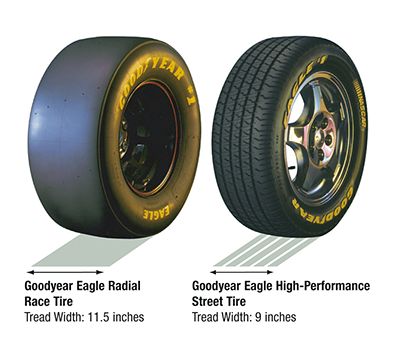
At first glance. a race tire looks fairly similar to your ordinary road tire.


They couldn't be any more different, however. The most noticeable difference is the tread pattern. Typically, the tread of a race tire is slick, as shown above. This is to maximize the tire's contact patch with the ground, thereby maximizing grip.  Many formula racing series do have rain tires for when it rains when they are running on road and street courses. This look much like a road tire in that there is a tread pattern rather than being slick. There are two different sets of rain tires, intermediates, and full wets. Intermediates are used when the track is wet, but little or no water is actually falling onto the track, whereas full wets are used when there is steady, consistent rain falling on the track. There are even more tread patterns for dirt tires, ice tires, etc. My specialty is formula racing, where neither of these are used, so I won't talk about them.

Many other differences come about due to the speed difference. Road tires are typically designed to maintain speeds up to 100 mph, where as a race tire has to endure speeds of over 200 mph! This means that the sidewall of the tire (the part where the manufacturer paints their logo) must be very sturdy so that the tire does not flex much. Speeds this high, as I'm sure you can imagine, lead to very high amounts of friction, and the tire starts heating up quite significantly, usually around temperatures where water begins to boil. To maintain the integrity of the tire and to keep it from blistering, the treads are incredibly thin, around the thickness of a credit card for slick tires (!!!). This temperature increase also means that the cold pressure of a racing tire is generally fairly low, around 20 psi where your car's tires have around 35 psi. Rain tires have much thicker treads and carry higher amounts of heat, but are cooled by the water on the track, so it is less of an issue. You typically want the temperature of the tire to be uniform, as this means that the entire surface of the tire was in contact with the road. If the middle of the tire is warmer than the edges, the tire is overinflated (and the other way around). Although for initial tests, it may be beneficial to overinflate the tire to see if the suspension needs tweaking to ensure an even contact patch (more on suspension at another point in time). You may have also noticed that pit crews seem to work effortlessly when changing tires, when you know your tires to be relatively heavy. It is not because the crew has superhuman strength, it is because the tire is so light!

Another thing to note is that the compound of the tire changes from track to track. Most tires are made of a synthetic rubber made from various chemicals, and the change in the recipe of the chemicals lead to a different end compound. These compounds change the overall "grippiness" of the tire. A tire with lots of grip is said to be "soft," and a tire with less grip is said to be "hard." There is a trade-off, however. Softer tires tend to degrade much quicker than hard tires, to you may only get a few laps of tire integrity before they start wearing away. (Yes, even race tires wear!)

I'm no expert on tires, and I'm sure there's far more that goes into them than even what I explained! I bet you never realized just how much goes on with something as mundane as tire. Race tire scientists and engineers certainly earn their income! I cannot remember the last time a Firestone failed in an IndyCar race.

Hopefully I'll get to keep doing these about once a week. Since I already alluded to it in this post, I'll probably talk about suspension next. Finals are next week, as well as checking residents out of the hall. It may be more like a week and a half, if not two weeks. If you have any questions, feel free to comment!