Showing posts with label science. Show all posts

Thursday, April 28, 2011

The Science of Racing: Tires

I don't get to talk about racing enough, so I've created a new series where I'll get to do just that. Once a week (if time allows) I would like to talk about something that makes a race car far different from the one you drive all the time. A big one is aerodynamics. That, however, is my bread and butter, so I'll save it for later.

The first component I would like to talk about is inarguably the most important part for any automobile: the tires! Why are they the most important, you ask? It's the only part of the car that actually touches the ground!

At first glance. a race tire looks fairly similar to your ordinary road tire.
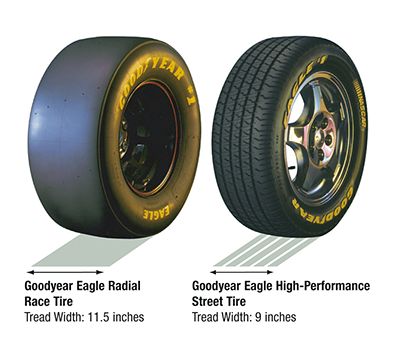

They couldn't be any more different, however. The most noticeable difference is the tread pattern. Typically, the tread of a race tire is slick, as shown above. This is to maximize the tire's contact patch with the ground, thereby maximizing grip.  Many formula racing series do have rain tires for when it rains when they are running on road and street courses. This look much like a road tire in that there is a tread pattern rather than being slick. There are two different sets of rain tires, intermediates, and full wets. Intermediates are used when the track is wet, but little or no water is actually falling onto the track, whereas full wets are used when there is steady, consistent rain falling on the track. There are even more tread patterns for dirt tires, ice tires, etc. My specialty is formula racing, where neither of these are used, so I won't talk about them.

Many other differences come about due to the speed difference. Road tires are typically designed to maintain speeds up to 100 mph, where as a race tire has to endure speeds of over 200 mph! This means that the sidewall of the tire (the part where the manufacturer paints their logo) must be very sturdy so that the tire does not flex much. Speeds this high, as I'm sure you can imagine, lead to very high amounts of friction, and the tire starts heating up quite significantly, usually around temperatures where water begins to boil. To maintain the integrity of the tire and to keep it from blistering, the treads are incredibly thin, around the thickness of a credit card for slick tires (!!!). This temperature increase also means that the cold pressure of a racing tire is generally fairly low, around 20 psi where your car's tires have around 35 psi. Rain tires have much thicker treads and carry higher amounts of heat, but are cooled by the water on the track, so it is less of an issue. You typically want the temperature of the tire to be uniform, as this means that the entire surface of the tire was in contact with the road. If the middle of the tire is warmer than the edges, the tire is overinflated (and the other way around). Although for initial tests, it may be beneficial to overinflate the tire to see if the suspension needs tweaking to ensure an even contact patch (more on suspension at another point in time). You may have also noticed that pit crews seem to work effortlessly when changing tires, when you know your tires to be relatively heavy. It is not because the crew has superhuman strength, it is because the tire is so light!

Another thing to note is that the compound of the tire changes from track to track. Most tires are made of a synthetic rubber made from various chemicals, and the change in the recipe of the chemicals lead to a different end compound. These compounds change the overall "grippiness" of the tire. A tire with lots of grip is said to be "soft," and a tire with less grip is said to be "hard." There is a trade-off, however. Softer tires tend to degrade much quicker than hard tires, to you may only get a few laps of tire integrity before they start wearing away. (Yes, even race tires wear!)

I'm no expert on tires, and I'm sure there's far more that goes into them than even what I explained! I bet you never realized just how much goes on with something as mundane as tire. Race tire scientists and engineers certainly earn their income! I cannot remember the last time a Firestone failed in an IndyCar race.

Hopefully I'll get to keep doing these about once a week. Since I already alluded to it in this post, I'll probably talk about suspension next. Finals are next week, as well as checking residents out of the hall. It may be more like a week and a half, if not two weeks. If you have any questions, feel free to comment!


Tuesday, April 26, 2011

Science > Engineering

With my distaste of engineering manifesting itself recently, I thought I would take some time to list the grievances I have with engineering. Here goes.

  • With science, there is only one answer. The world has many problems that need to be solved. If you were to give six groups of scientists the same problem, they would come up with the same answer. If you were to give six groups of engineers the same problem, you would get six completely different answers (as evidenced by my senior design class this semester), and there would be absolutely no rules or standards to determine which was the best solution. There is far too much ambiguity in engineering.
  • Science is forever. If you make a breakthrough in engineering, you change the world for the near future. Somebody will just come along and make something better than your thing in a few years. The cycle never ends. If you make a breakthrough in science, it changes the world FOREVER. Besides, it's the scientists that are defining the work that the engineers are doing.
  • There is too much pressure in engineering. Scientists have been looking for the Higgs boson for what, sixty? Seventy years? If it were an engineering problem, they would have given up after a month. Scientists can devote their lives to figuring out one thing that really drives them. If you can't get a problem figured out quickly as an engineer, the company loses money, and you're out of a job.
  • Science is just plain cooler. I mean, this is probably pretty subjective, but uncovering the secrets of the universe is much more amazing than doing things like designing heat exchangers and high-lift devices with your life.
Another I have isn't so much a grievance as it is an observation. To be successful as an engineer, you MUST be 100% passionate about machines, especially the one you are devoting your life to designing. The only machine I have ever been 100% passionate about is race cars. I studied engineering because I wanted to design formula race cars. As I grow older and wiser (I know, a laughable claim considering that I am only 23), I realize the last thing I want to do is follow that dream. I love auto racing! And I would never be able to enjoy watching a race again if I were to actually work in auto racing someday. 

I'm sure there's more I will think of in time. I've only been pondering this for around a week now, but I feel this is a pretty good list for such a short amount of time.

Thursday, April 21, 2011

Identity Crisis

Today I had my final presentation for senior design. Our design was getting ripped apart, and I finally had a moment of clarity. I don't want to be an engineer. And it's not because my team's design got ripped apart, either. Engineering is a sciency field, but I don't think it is concrete enough for me.

Our design was getting slammed mostly for inconsistency due to different values researched by each of us individually, but they were not cohesive enough when we tried to bring our results together. I don't want to be using science to create technology, I want to be creating science that in turn spurs technology.

As an engineering student, you don't realize the nitty-gritty stuff until you get pretty deep into your plan of study. At this point, I am only three weeks away from getting my degree. I might as well finish it out.

I'm just not passionate enough about making machines to do this the rest of my life. The shows that captivate me the most on the Discovery and Science channels all talk about the science itself. If there were a show outlining every individual system on an aircraft or spacecraft, I'd switch it off. Engineering is all about the teeny details, and I've always been more of a "big picture" kind of guy.

Somewhere down the line, I believe I'll be going back to school, but this time, to study science. Probably physics. I initially went into engineering because I thought I enjoyed the application of science into technology, but I have found that the science itself captivates me much more. I couldn't care less about the particular high-lift devices employed by an aircraft. The science of why those work interest me much more. I couldn't care less about specific chamber pressures on a rocket engine needed to generate enough thrust to get a spacecraft to a high enough velocity to maintain orbit, but the astrophysics involved in keeping the craft in orbit interest me greatly.

It is true. I am a scientist, not an engineer. I wish I would have realized that a few years ago, though. I have received training in something I am somewhat interested in, so it shouldn't be TOO painful to work for a few years and repay some debt before attempting to go back to school to get a degree in physics. Unfortunately, I believe that my lack of interest in engineering resulted in such a low GPA that I may have to start from the beginning with a bachelor's degree, I probably won't be able to get into a master's program...